
From Puzzle Pandemonium to Purposeful Play: How a Little Competition Transformed My Classroom
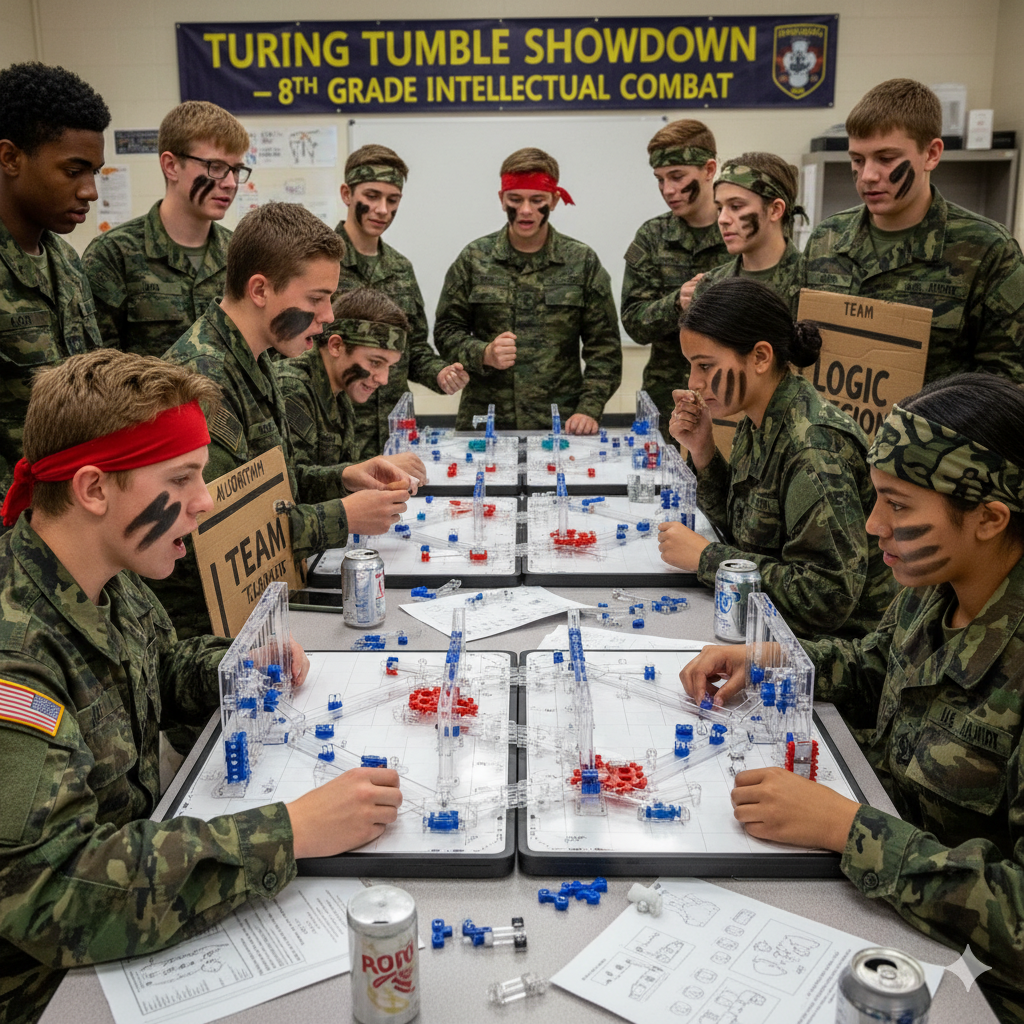
Every teacher knows the feeling of navigating a class with little to no budget. So when I asked my principal about purchasing robots, I wasn’t surprised when the official response came via a text message: ‘Will this work?’ Pictured was a stack of Turing Tumbles. Not exactly robots, but it is a brilliant hands-on tools that teach the fundamentals of computer logic. Students place marbles (the input) at the top, and by arranging a series of ramps, gears, and switches, they aim to get a specific pattern of marbles (the output) at the bottom. It’s a mechanical, marble-powered computer.
For the students who live for logic puzzles, it was an instant hit. But for about half of my 8th-grade class, this amazing tool was just a colorful, confusing nightmare. Here’s how my “game-changing” lesson went off the rails, and how an unexpected idea brought it back to life.
Day 1: The Flaw in the Plan
My initial plan seemed solid: randomize the students into pairs. The hope was that the puzzle-lovers would naturally mentor their more hesitant partners. Instead, I got two immediate problems:
-
The Social Drama: “I’m not with my friends!” The groans and resistance to working with someone new created a wall of negativity before we even started.
-
The Logistical Hurdle: Before any logic could be learned, students had to wrestle with the initial setup, a surprisingly time-consuming process that drained our precious class time.
The first day ended with more drama than learning. It was clear this wasn’t working.
Day 2: Chaos and Capitulation
Things went from bad to worse. On the second day, I lost half my class to choir lessons. The carefully randomized groups were shattered, leaving some students to fly solo while others struggled in their already strained partnerships. Then the choir kids came back halfway through, and some couldn’t get into a group. These students also had less time to make the Turing machine work. By the end of the day, I’d estimate that only about half the class truly understood the rules of the game, let alone the deeper logic behind it. The lesson was on life support. I felt like I had failed to make this incredible resource accessible to everyone.
Day 3: A Spark of Inspiration
That evening, I was thinking back to a book from a college cultural competency class: For White Folks Who Teach in the Hood… and the Rest of Y’all Too by Christopher Emdin. He writes about the power of competition and describes how battles, and the purpose behind training, can fuel motivation. This channels energy into perfecting skills instead of wasting it on tribal infighting.
It hit me: while my students weren’t ‘infighting,’ their social drama and frustration were a similar waste of energy. The abstract puzzle lacked purpose. My students needed a battle!
The next day, I changed the rules.
-
Strategic Alliances: I ditched the randomizer and strategically paired students. Each group consisted of one student who clearly understood the Turing Tumble and one who was struggling. They were now a team with a shared mission.
-
The Challenge is Issued: I announced that all teams would be competing against each other to solve the exact same puzzle challenge.
-
The Spoils of Victory: The first team to successfully complete the challenge would win a treat of their choice. The winners chose a “Twix” candy bar.
The Transformation
The shift in the room was instantaneous and astounding.
The social drama evaporated. Suddenly, it didn’t matter that they weren’t with their “bestie.” It mattered that their partner had a skill they needed, or vice versa. Concentrated teamwork replaced the sighs and complaints. Students who had been staring blankly at the boards were now leaning in, asking questions, and pointing out ideas. The “expert” students weren’t just giving answers; they were coaching, explaining their reasoning with a new sense of urgency.
But the most incredible part was who won.
One of the first teams to solve the puzzle was led by a student who is often perceived by their peers (and sometimes themselves) as “not smart.” As their marbles clicked into the final tray in the correct pattern, I announced the winner. The room clamored with disappointment, disbelief, and denial as some students shouted out that they, too, had almost solved it.
For some of the more typically high-achieving students, this was a shock. You could see the primal frustration on the faces of some of the students when they realized they’d been out-maneuvered. They had been served a much-needed piece of humble pie.
The Real Victories
In the end, this lesson was a success beyond anything I could have planned. Yes, they learned advanced logic concepts, but the takeaways were so much bigger:
-
The Power of Teamwork: They learned that leveraging a partner’s strengths is more effective than working alone.
-
Confidence for the Struggling: The students who constantly put themselves down discovered they had valuable problem-solving skills. Seeing their success changed how they saw themselves.
-
Humility for the Confident: The “smart” kids learned that intelligence comes in many forms and that no one has a monopoly on good ideas.
-
Breaking Stereotypes: The entire class witnessed their preconceived notions of who is “smart” and who is “dumb” get turned upside down.
Sometimes, the best-laid plans fail. But by giving our students a clear purpose, even one as simple as a friendly competition, we can turn a lesson in logic into a life lesson in collaboration, humility, and self-worth.
Disclaimer: This blog was co-written with the help of AI.